Uncategorized

Nepal is closer than you think.

Today I received an email from my niece. She wants the family to know something. And I want my readers to know something, too.

“My Nepali Adoptive Family Association has established a fund that is being distributed, by hand, to each of the orphanages that we came from.”

Sirjana is 7. To say she has thrived here in the US is an understatement. Her mother maintains close ties with other Nepalese adoptee families in the States, especially children adopted from the same orphanage. Sirjana’s roots are as firm in Nepal as in her American family, thanks to her mother’s perseverance. The Nepal earthquake disaster, as a result, is not so far away for Sirjana, for her Nepalese friends and now, for me. The earth shrank when I continued reading:

“These funds are being hand delivered to each orphanage as the needs are being assessed and allocations are being made on site. Some places need new homes, others only tents for temporary shelter. Some need medicines or food etc…. Each situation is unique and our Association receives reports each day from our person on the ground there – as well as pictures and notes.

For all the pleas we have seen for funds, her note struck me especially hard. How impossibly and unimaginably difficult the task of helping seems: Can you make a decision for funds, in those ruined villages, on an ‘as need’ basis? What is your criteria for ‘as needed’ when you look at the news coverage? Children? Animals? Shelter? Food? Roads? Our cultures are too different. Our houses too strong. I have felt helpless and privileged every night when I watch the news, shop for dinner, go to the gas station, pull a blanket over myself. I see Sirjana in the photographs.

Here are the children and their caretakers living outside of Sirjana’s orphanage, in fear of the building being further damaged from aftershocks.

11156267_878997282157227_2536500792793097202_n

Sirjana’s first grade class has also began gathering donations for the Red Cross Nepali Earthquake Relief Fund. They raised $1,000 in 12 hours. The class decided to push on and triple the donations.

Because of orphanages like the one Sirjana was raised in, we have a beautiful, smart and loving little girl in our family. Because of my donation, I will put a piece of tarp over a child’s head, or supply food, or fill a gas tank. So simple, and yet, so incredibly complicated.

I am humbled. And grateful she asked her mom to sent us all a note. Nepal suddenly doesn’t feel so far away. And I don’t feel so helpless, after all. I’ll see what I can do to help, Sirjana. Thanks for writing me. Love the face paint.
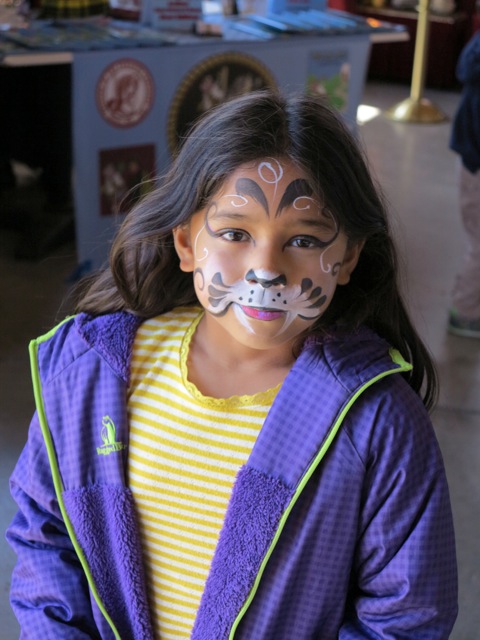
Image 2https://www.crowdrise.com/firstgradestewardshipfornepal

 http://www.gofundme.com/swa2zy4c

Standard
Uncategorized

Grain of Sand

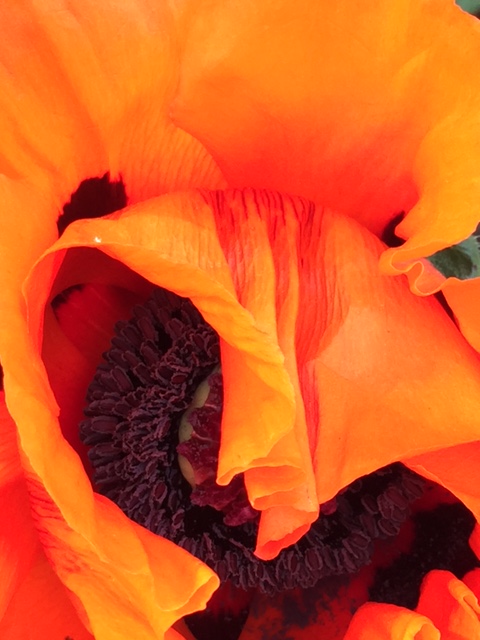
 poppy

     I am coming to the end of a program in Seattle, this writing group at the stage of cobbling our chapters together, making outlines for the chapters still simmering in our heads, dusting off book proposals, and in my case, sending a few chapters out into the publishing void, hoping for feedback, a nod, and the ultimate goal, publication. There is still much to do. Today, after a hand-written rejection note arrived, I realized the small details make a huge difference: Someone took the time to pen a note to me, not just clip a form letter to my work.

     I was feeling overwhelmed as this week unfolded, that my problems were like mountains– craggy, steep and snowy — perhaps impassible. Then other news began to leak in: A friend’s child has a severe swimming accident in France. A woman I adore loses the last of her hair, for the second time. Another woman friend had brain tumor surgery. Earth Day reminded me of a passionate young woman lost a year ago. My children are making life decisions. Then my piece was rejected.

     But the small gesture of a hand-written note elevated the rejection to another level, believe it or not. The personal words conveyed acknowledgment. I posted this on our writing group Facebook page and fellow writers sent me notes of encouragement and applause. I realized from their notes that I have a tribe, people like me in classrooms and living rooms and coffee shops, aiming to set into words stories and thoughts both personal and universal. Their words give me the confidence I need to sit down again to my work.

     Today I will write a dozen notes to friends I am thinking of — to congratulate them on birthdays and coming home and beautiful skin and special memorials and strength — writing on my blue note paper with a cheerful sparrow etched in the corner. And I will touch them as others have touched me, with small words, and remind them about their tribe that surrounds them near and far.

     I am a tiny piece of all that is happening around me. My problems survivable. I don’t have to climb them alone. I re-read the rejection note, a small gesture with large importance, and drop it into my ‘rejection’ file. Pull on my hiking boots and pull the laces tight. I will go smell the lilacs blooming down the street, and pause to admire the poppy that unfurled yesterday.

To see the world in a grain of sand

And a Heaven in a wild flower,

Hold infinity in the palm of your hand

And eternity in an hour.

(William Blake, fragment from ‘Auguries of Innocence”)

Standard
Uncategorized

Meet Me Under The Apple Tree.

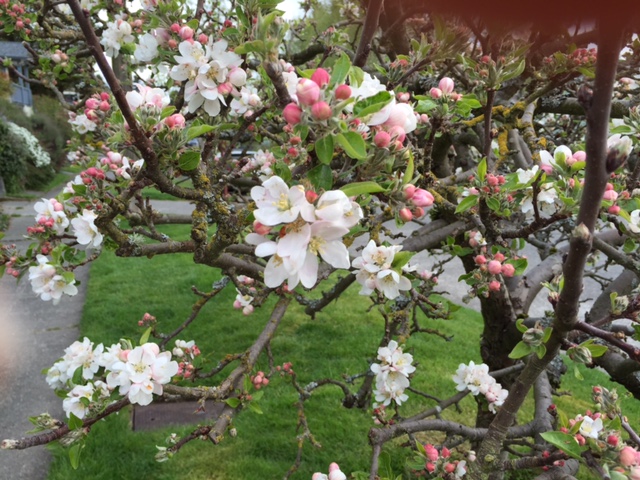
Appletree5.2015

I arrived back in Seattle last night, from the other coast still locked in the dregs of winter, discarded road salt and broken branches. A few of my hyacynth bulbs were poking through the leaf mold, and the lilac buds were setting strong and green, but spring itself is late and dawdling in Massachusetts after the record-breaking winter snows.

Traveling back and forth has been a time warp for me this season. Seattle spring has been weeks early and everlasting. It’s raining on Phinney Ridge today, but on my coffee walk I came upon a sweet little dwarf apple in full bloom, and my heart gave a little jump of joy.

I have a thing for apple trees. No doubt because when I was four years old, my parents purchased a defunct dairy farm in Guilford, Connecticut, circa 1800’s. For the next two years they converted the main barn into a contemporary home; a 20-foot high wide-beamed peaked ceiling, the main floor entirely open end-to-end, enormous green shag carpets, haylofts enclosed for our bedrooms, open balconies connecting the upstairs. My brother and I never knew walls. So unusual was the concept, we were even in a photo spread for House Beautiful in 1964. But what I remember most were the apple orchards. Especially now, fifty-two years later, when the sight and smell of an apple tree in spring makes my fingers itch to climb a limb and lean back into scratchy bark and breathe the spicy sweetness of the blossoms, aswarm with bees.

Having open space was almost as important as reading books for the child-me. But the two went hand in hand; with whatever series I was devouring tucked under my arm, I would set out into the orchard and either lean against the warm trunk or find a low branch to scramble. Picture being lost in a Nancy Drew conundrum, thrilling to the young reader, and lulled by the low hum of bees in the pale pink cloud of craggy branches. The world falls away. The words come alive.

Yes, sometimes I napped. And sometimes spending hours reading, alone in the country, was not the best social developmental plan for me. But I love how intrinsically woven together my memories of reading and the outside world are, thanks to that crazy decision my parents made fifty-two years ago.

Give them space and they will grow. And I did.

I am a reader now. I always carry a book. I read on park benches. I read on the bus. I am the type of person that can read anywhere — case in hand, I consumed an entire light-fiction airport paperback on my coast-to-coast trip yesterday. I didn’t look up until we descended. Not the two screaming children or the turbulence lifted my head for the five-hour flight. And the little tree today reminded me that I have a stack by my bed begging to be selected and dissected, despite the hydraulic drill next door or the construction below my apartment. And when it stops raining I may just sit a while under the branches and keep a look out for bees.

Thank you, Spring.

Standard
Uncategorized

Reunited.

Today I was reunited with a first love. We met in 1969, on a worn plush bench at The Phillips Collection in Washington, D.C.  To the disgust of my artistic and hip mother, dragging me to galleries on spring break to ‘widen my horizon,’ I walked into one of the many parlor rooms, took one look at Pierre-Auguste Renoir’s Luncheon of the Boating Party (1881), and could not be budged. She glided off to meditate in the Rothko room, and I spent the next hour imagining and spinning tales, as only an eleven-year old can do, about the beautiful women and men caught laughing and eating on the larger-than-life canvas suspended on the wall.

Duncan Phillips (1866-1966) began amassing an astonishing collection of art as a young man, that he proceded to hang throughout his elegant Georgetown home. He believed that mixing all valuable art together, non-chronologically and non-traditionally — on walls and tables and cases — would demonstrate the ‘universality of art.’ Tea was taken under Klee and Buddhist tapestries. He read under Predergast hung with Miro. He walked the panelled hallways with Matisse looking over his shoulder, and Man Ray in the alcoves. And in 1923, the raucous and historic Boating Party found a home in the front parlor.

The house became a bonifide musuem in the 1920’s, purposefully retaining the trappings of a home amongst the art. When I scuffed my Keds through the door in 1969, there was no fee. We just walked through the front door and drifted through the house, still sparsely furnished with sofa’s and settees, and winessed the Duncans’ passion for collecting and memorializing paint, wax, metal, wood, canvas, ceramic, fabric. Art.

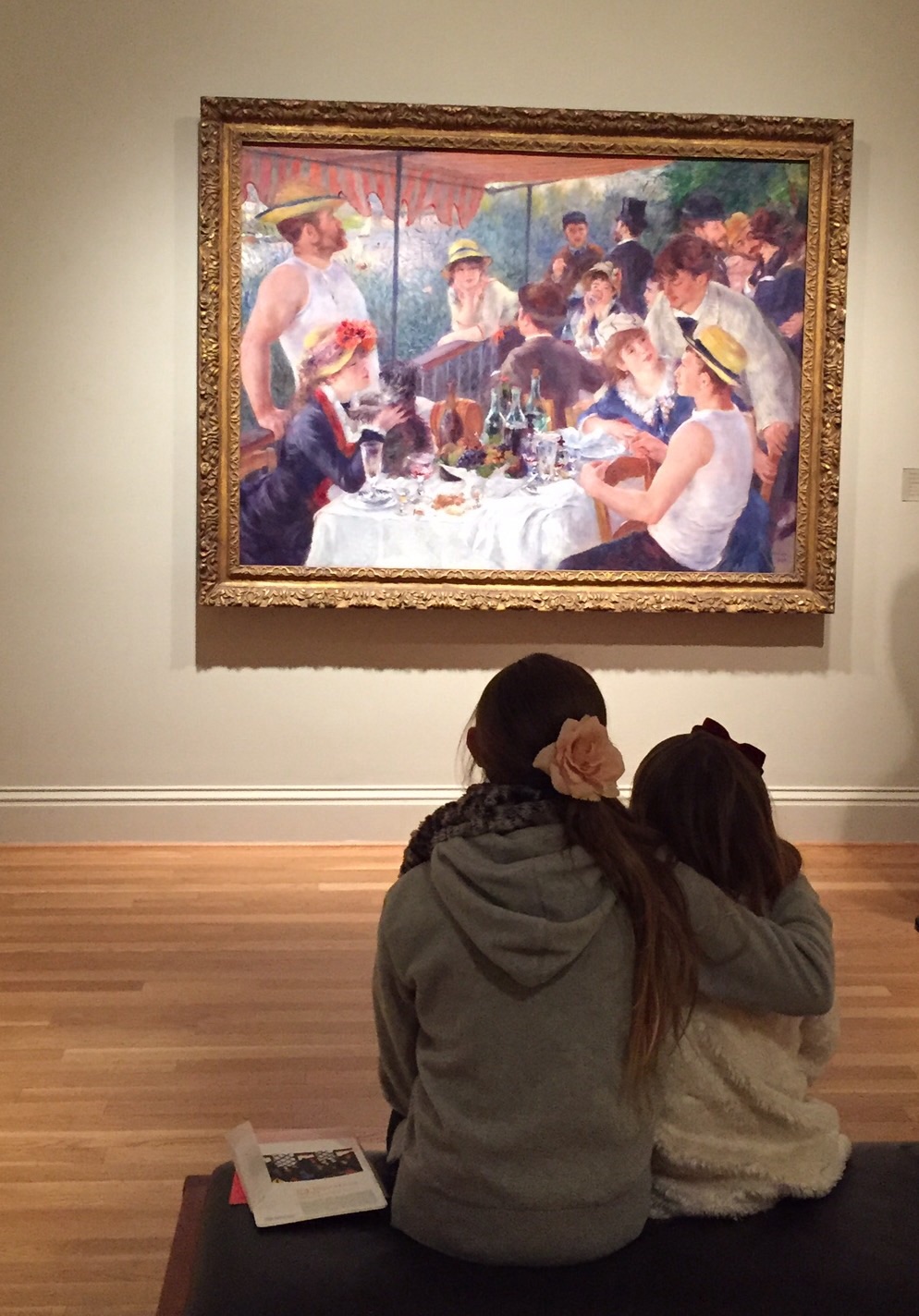
Impressionism impressed the romantic little girl in me. In the lower front left corner of Boating Party, a woman in a sprigged hat kisses a dog, elbows on the table, inches from a sumptious platter of fruit. A man sits backwards on a chair, admiring her. A straw boater tips towards a striped awning, the white t-shirt bright, a small red beard. A top hat moves in the background towards the rear. The water sparkles and the light deepens in the corner, suggesting lunchtime is long gone, the party is relaxed and no one is in a hurry to leave.

Today, I paid $12.00, clipped a pin on my collar, and pushed through glass and chrome doors to the now three wings of The Phillips Collection. I found my Renoir, in a similar room complete with a reproduction fireplace and a cushioned bench awaiting me in the center. I sat alone, and downloaded the Phillips Collection app for information on the painting. In the recording, the director of the collection explained the brush strokes, the models — all friends and colleagues of the artist — Caillebotte sits in the chair, Aline Charigot holds the terrier and later marries Renoir, Charles Ephrussi the art dealer wears the formal attire. And the list goes on.

We are not in 1969 anymore. Does the app take away the magic? Do the new galleries, built over the last forty years for the expansive collections, change the sense of living amongst Duncan Phillips’ art? Well, most probably I will forget the details in time, and I can now access the information whenever I want to, online, anytime. They galleries are still small, and the original house is mostly accessible, with a smattering of old and modern art sprinkled together, like old times. And all the floors are still wooden and still creak.

I went through the building top to bottom, enjoying a room made from wax and yes, the Rothko room. When I passed the Renoir one last time, I peeked into the room to say ‘goodbye.’ I am pleased to report Luncheon of the Boating Party has lost none of it’s magic. Not a cellphone in sight, just two little girls falling in love.

image

Standard
Uncategorized

B is for Best Moments

Olive

This morning, after the morning biscuit + espresso stop, Olive and I wandered under the riotous cherry and plum blossoms in our Greenwood neighborhood, reveling in the beauty of spring.

Down the hill a group of children were heading towards us, exuberantly shrieking “O is for Owl!” and “P is for Pot!” darting back and forth on the sidewalk in a wriggling mass of sweaters, tiny pink rain boots and dragging jackets, trailed by a young women with a clipboard, dutifully noting their Alphabet discoveries.

I stopped, conscious that not all adults like to have dogs around children, and waited for the woman to give me direction. But the children reached us in a flash, and Olive was surrounded by little heads and hands bent over her, asking if they could pet her. I thought her tail would wag off as she barreled right into the middle of the writhing mass, pressing herself against the legs of the nearest little boy.

A tiny girl in a tutu pointed down to her.  ” B is for Black!” she said. And then a little boy looked up at me and said, ‘your coffee cup is Black!” and another child hopped up and down and said ‘your tights and skirt are Black!”

“Even better,” I said, “her name is Olive!” and they all screamed, “Olives are Black!” and we had a great laugh. Then off they careened, pointing and shrieking and kicking up the blossoms on the hilly sidewalk.

I was turning when I felt a small hand on my leg. I looked down and saw that one little boy had come back down the street to me. Looking up solemnly, pointing with his outstretched arm, he said,

“Be careful, there’s a lion on the porch of that yellow house.”

I returned his gaze without a smile.

“Thank you,” I replied. “We will be very careful.”

He nodded, and skipped back up the hill to the group.

Made my day. Even the scary lion.

Revel in random moments, pink blossoms, and little rain boots. Life is good.

Standard
Uncategorized

Note To Self: 424 N. 68th Street, Seattle, WA 98103

letters

I am the keeper of the family letters. Boxes full. Old leather trunks full. Musty folders full. I have letters dating from the 1800’s, so crumbly I don’t take them out of the envelopes. Addressed with only the name and the town of my relatives. Stamped with a one-cent stamp.

An Organization professional would have a field day (yes you Susan Stone) but I hoard them like jewels. Each time I set a box on the floor or unbuckle a trunk, rifle through the onion skin airmail paper, see the familiar left-hand or right-hand slanted loops in royal blue ink, I dig a little deeper into the mysteries that were my family.

Recently, I am trying to decipher letters my mother wrote to her parents in 1955 from Spain, to round out some details in my memoir. She sort of ran away on the pretense of a semester abroad, a decision both Mount Holyoke College and my grandparents immediately regretted. A family story, a bit of romance, and a slippery stack of letters written in English, Spanish and ticked-off college student. I need full sunlight, complete patience and time to work through the papers. A lot of time.

After I spend some time on these letters, writing an email feels like a cheat to me, even though I send dozens a day. My New Year’s resolution has been to take one day a week and send handwritten cards, letters or postcards. Actually uncapping a pen, clearing my table, setting out my box of writing paper. To be truthful, after a few written sentences, the bend in my wrist actually feels a little awkward. Who isn’t accustomed to the ticking tapping speed of a laptop? Who besides me relies on the autocorrect slash of red to alert lazy spelling, the quick press of the ‘send’ button to land the message seconds later in the ‘mailbox’ of the recipient?

Instead, I resolved to spend the time, pick just the right paper or card, sit with tea and think about my words. I have to write the sentences in my head, script them in a measured movement, I even fuss with which stamp goes on which letter.

When I am finished, I feel so satisfied with the stack on the kitchen side table awaiting the next dog walk. The different colored envelopes, the saucy postcard graphics. I like to anticipate the parcel of letters in my pocket, the time it will take for the correspondence to travel and where they are going: To a metal mailbox, a brass mail slot, or perhaps slide under a heavy wooden door, wet with snow. Hands will touch the letters, hands will deliver the letters. Hands wrote these letters.

When I re-read my mother’s words, her funny requests for a certain wool suit, a check, my grandparent’s approval for another semester because she has fallen in love, I want to fall back in love. I want to take the trans-Atlantic ship to France. I want to slow down my life and watch the curling letters fill a crisp page. Her handwritten words capture a slower speed of being, a time of telling stories, of reading stories, of waiting for stories. I miss this.

I’m going to take the time to actually write, not just text or email. I don’t want to lose the art of taking time. And I’d love a letter. If you send me one, I will know you had to think about your words. Sign your name with a flourish.

I hope you do.

Perhaps someone will read the words you write to me fifty years from now, and remember.

Standard
Uncategorized

Any Given Day: On Grief.

My mother appears when I am in the linen closet folding bath towels. Straightening the washcloths or color-stacking the different sizes into neat rows.

I hear, clearly, “you have GOT to be kidding me,” the c-minor tone of her disapproval filling the closet. I am now fifty-six years old and my chest muscles still constrict the same way as when I was ten, fourteen, twenty-two, then my ears ring and a little vertigo shifts my gaze. I frown and peer in between the snowy face cloths, knowing better, but forced to defend myself, talk back into the soundless, empty closet.

“Go away. You know this is what I like to do!” I say, feeling like an idiot.

She has been dead twenty-nine years.

We joked about these encounters before she died. I shook my finger at her with a smile on my face, told her not to float out of the linen closet, that I was born tidy, and attentive to details — wasn’t she always glad one person in the family knew where everyone’s shoes were?  So leave me alone. We got a good laugh but I think she had a twinkle in her eye, or that could have been the elevated morphine to dull the steady march of rogue ovarian cancer cells. Secretly adding ‘linen closet’ to her list of places to visit me ‘after.’ And adding to the many diverse places that grief can sideswipe me on any given day.

Twenty-nine years is a wink of time when you have loved someone so deeply and their death has re-landscaped your heart. Read Elisabeth Kübler-Ross’ book, On Death and Dying, written in 1969, the bible of sorts on what to expect from bereavement. I did, from cover to cover, the four years my mother was ill. Trying to anticipate how I would strategize through each stage when the time came. But denial, anger, bargaining, depression and acceptance, the Kübler-Ross model of grief, did not, as it happens, present in a straight line. Instead, I rocked and rolled in a scrambled, upside-down mess for a long time —years — after my mother died in 1986. The good news and the bad news is that the roller coaster continues today: I have come to realize over twenty-nine years that grief  — the breath-snatching, heart-tearing, body-numbing strike of familiarity or sadness or even humor — presents itself, for the rest of your life, in utterly surprising and unsurprising ways.

Try reincarnation: My mother appears when my oldest daughter —conceived unknowingly in my mother’s final days and named after her — laughs, throwing her head back and gulping in air, so that I often have to look away, blinded by the sound, the tilt of head, the evenly shaped teeth so familiar it hurts.

And smell: When my youngest daughter sits down, pulls out a pencil, and draws a sketch of the scene in front of her I am swept back into my mother’s studio, looking over her shoulder as the lines magically fall from her fingers onto the page. My awe, and my own artistic talents, have not changed since kindergarten. Now I have another grown woman in my life who makes magic on the paper, who asks my opinion, who humbles me with effortless talent.

She complains, “Mom, what’s the matter with you, are you paying attention, what do you think? my youngest is impatient for praise and dismissive of any criticism, the sure-footed ego of an artist rebuilt from my mother’s DNA into hers so seamlessly. I stammer out admiration, while all the while the smell of old studio oil paint and my mother’s Balmain Vent Vert perfume fills my nostrils and stings my eyelids, making my mouth go dry and words to stick.

Always, memory: A month ago, when going through the death of a friend, my son came home for a family dinner. When our meal was over he stood up, cleared the dishes, and carried them into the kitchen where he proceeded to wash them all by himself, methodically and meticulously, bending his long frame over the sink and dishwasher in a steady, thoughtful rhythm. I let him be. His concentration and silence, his solace from this task, shot me back into the Bainbridge Island farmhouse kitchen in 1986, the summer my mother was dying. My brother, at twenty-three years old, carefully leaning over the sink, unscrewing the washer, tapping the faucet, running the water, silent but occupied, finding solace in his task, in this distraction, in his usefulness, while my mother’s breath grew shallow and infrequent in her bedroom upstairs. My heart broke for my brother then, my son now, and myself that we are veterans of death,  survivors of loss, expert in the ways of sadness.

It is conceivable to say that we always grieve, because we will always remember. But I have come to understand we will be reminded in surprising and beautiful ways not so much heart breaking but consoling. I see my mother in my children. I hear her annoyed voice in the closet and laugh as I slam the door shut on her. I know how to stand aside and let grief work.

My mother would approve of her grandchildren. She will always give me a little shove and remind me to loosen up. She will always be with me in so many ways.

And I am glad.

IMG_3013

Standard
Uncategorized

Perspective.

Quince2.15

Keeping things in perspective has been on my mind the last twenty-four hours. Not just because the quince are in full bloom here, while back in Boston they have had 77.3 inches of snow in the last two weeks. I continue to be grateful for even limited use of my arm as I recover slowly from a ‘frozen’ shoulder which didn’t work at all a month ago. I chug along on my writing project, that a few years ago seemed incomprehensible.  But today I am back to a basic reality because of what I witnessed as I breezed in and out of Whole Foods yesterday.

As I stepped in front of the Roosevelt Whole Foods from the crosswalk, a man bundled in grey clothing, sitting on a crate, whispered to me as the doors opened. So hardened by the sheer numbers of panhandlers in Seattle, I have adopted an invisibility cloak when I pass — turn my head, keep walking, hear nothing. As the doors closed behind me I heard the trailing voice say, ‘just some coconut water,’ or so I thought, and I puzzled over this through the sparking aisles, picking out my ingredients for peanut chicken soup.

After paying at the register, the doors wheezed open and I saw a mother, with a young child, standing in front of this man with her phone out. I heard her say, “what else? Don’t worry about it.” And the man on the crate said, ‘I’d be grateful for some coconut water.” And my cloak fell off and I stared. She was collecting his grocery list. She was headed in to purchase not only her items, but what this man needed.

Not handing him money. But handing him kindness, and compassion, and a hand up. Like the woman in the story I reposted on Facebook, “A Blizzard of Perspective,” who rolled down her window and unlocked her car door and made the world easier, for an evening, for a commuting mother and child.

Keeping it all in perspective. Being grateful. Paying it forward. Tag, you are it.

Standard
Uncategorized

Hugs. In Remembrance.

Kendra

Kendra burst out of the dorm door at St. Georges one afternoon in 2010 with my daughter, spied we were wearing the same old-school Ray Ban sunglasses, and with one gigantic shriek, grabbed me in a bear hug and declared we were sisters.

Kendra had a lot of friends and sisters.  One only has to read the remembrance Facebook page, visit her home, sit on her memorial bench to quickly realize how many people she embraced. Over the past twelve months, I have come to see where this came from — wrapped into the beautiful that was Kendra is all the wonderful of her family,:  Her funny, daring and sweet from her sisters, her deep kindness and compassion that is her Mom, her wiseness that is her calm and loving Dad. Kendra transcended age full of these amazing qualities, and so many of us, old and young, were proud to call her friend — and sister.

This year I have squeezed her family as many times as possible. A few weeks ago, at his son’s funeral, a father said, “if you touched him, you touched us.” When I hugged Kendra all those times I had embraced a family of fine, brave, wise and loving people for life. Thank you, Kendra.

I am now so conscious that we are all connected, in tight or loose webs, with anyone we hug, admire or work with. We have to take care of each other, no time more important than when there is loss. And for a long time after that loss. That is our human truth—we get through loss with the help of others. The day after, the month after and in the years after.

This weekend I will remember Kendra in a little church on Bainbridge Island, Washington, where my mother is buried. I will go sing a hymn and pray on my knees. I will be thankful for the spirit above that is now Kendra, and the family she gave me to love, cherish and hug in Newport.

I’ll be styling those glasses, too.

Rest easy, beautiful girl.

We love you.

Standard
Uncategorized

The Heartbeat of January, 2015

O

Yesterday I fell down the stairs. Now, this is not an auspicious beginning to the New Year of 2015. But to be honest, that is not what I was crying about, crumpled on the slick floor.

2015 began with another loss for our family, a New Year’s Eve death of a wonderful young man that has rocked my son, his former teammates, and a wide ripple of families that have shared St. Lawrence and lacrosse together. I want to put this in perspective but that is impossible. Instead, I want to put 2015 in perspective.

January 1st, 2015 turned out to not be a fresh start but a fresh hit on the head to remember what is important. A well-worn phrase but the only way we made it through January 1st, 2015. Family. Friends. Dogs. The sunrise over the evergreens. The sunset in the backyard. A warm, foamy espresso. A big bowl of spaghetti and meatballs. A green- enough tender leaf of lettuce. A cardinal in the heated birdbath. A few flakes of snow to transform the evening dog walk.

When we lose a young person the world shape-shifts, the pyramid of what is important gets restacked. I have forgotten the laundry pile. I am on the couch with my kids all the time, anytime.  I am petting my dog in the middle of the night. I will go and grieve with friends and strangers for two days this week and give strength to the family with my presence and love.

I have no words of new wisdom. I just want to say I am thinking hard about the value of our broken, beating hearts. The bruises from my fall are the least of my worry. But I may throw away those slippery socks. And a few other things that really have no meaning in 2015.

Standard