Uncategorized

The Life-Changing Art of…

This week I am tackling one of several spaces that have become storage — well maybe a graveyard — of memorabilia. I had no problem with tossing knitting projects that I will never attempt. I donated the dozens of unopened notebooks. There was no question the fifteen sets of single sheets, from decades of bunkbeds, would go to the Salem Mission. Cookbooks I haven’t cracked open for ten years — OUT. But after the garage and recycle bins filled, I was staring at paper. So much paper. Precious paper.

There is a lot of hype around Marie Kondo’s book, The Life-Changing Magic of Tidying Up. So as I opened the boxes, some eighty, ninety and even one hundred years old, I tried to channel her words.

“Just throw them away,” she orders.

But enter the conflict: She also consuls, “Keep the things that spark joy.”

Now what?

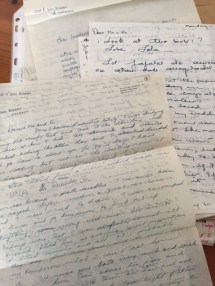
One box, marked ‘mementos,’ has childhood letters and cards my mother, deceased for thirty years, wrote her parents. Like this one penciled on crumbling, musty notepaper:

Alexandra Hammer, May 23rd, 1943

Alexandra Hammer, May 23rd, 1943

She married twelve years later, into a staunch German family where headcheese was the featured dish on the Christmas sideboard. This box brings me joy. My grandfather’s spindly, carefully penciled notation on the envelope notes, “Poems written by Alexandra with no help except for spelling during a practice air raid.”

I sit back on my heels, the contents of the box spread around me and this pile of paper sparks even more than joy. I close my eyes and see this little girl in pigtails, hunkered down next to her father, impeccable in his bowtie, delivering her best blow to the enemy. I remember my grandfather, the loving father who saved her notes so carefully in the rose-patterned box. He, too, recognized the legacy of remembering and holding messages from our past. I smile, knowing what I know, that she grew up just as feisty when the pigtails were cropped, when her marriage ended, when the cancer arrived.

I also found this drawing by my youngest daughter.

EDG, date unknown.

EDG, date unknown.

The pencil marks are thick, pressed deeply into the paper. If I had to guess, sketched when she was six or seven years old. But what struck me was the size of her prince compared to her princesses. She was getting  that right fourteen years ago, putting those princes into perspective.  Especially if he is wearing those ridiculous toe shoes.

I will be pulling this out for her wedding. This sparks joy, the thought she will find someone of her own one day, that looks her in the eye, that she deems worthy.

I am practicing the life-changing art of recognizing joy. These boxes of old, especially very old correspondence, travel diaries, love letters, Christmas cards tie me to my past, make real the invisible thread from then to now, from them to me. Make me happy. Make me think. I love a clean set of shelves as much as the next person, but sorry, I have to stack a few boxes there, after I’m done dreaming.

Standard
Uncategorized

#youmightbeawriter

AJ King bakery wall art, Salem, Massachusetts

AJ King bakery wall art, Salem, Massachusetts

Just the other day I turned to a friend in CVS and said: “If you are the emergency contact? And the nursing home staff has lost me during the drugstore outing — even with my walker? Just tell them to look for me in the school supplies aisle.”

I still get goosebumps when I see the stack of candy-colored notebooks, the bin of loose pens, the fresh and still slabs of legal pads secreted away on the vinyl shelves under the florescent lighting. Not just in September, any time of year. Perhaps I crave the un-rumpled sheets, the first pure streak of blue ink from a new Bic pen. But perhaps I love the promise, the potential, of all those writing receptors. They whisper to me, something like, “buy me, I will take your words, any of them. Just write.”

Crazy lady in Aisle 3.

Just write should be tattooed on the tender inside of our wrists, all of us that aspire. Rejection, success; in the end, we have to just write. Again. And again. I muddle through the middle, I zig-zag back to my prologue, I write the end with a flourish, then realize I have to just keep writing to get the words even better. I unwrap a new pad, put some more paper in the printer. I have the carbon footprint of a pre-historic dinosaur this year, judging from my recycling.

A few days ago a twitter challenge circulated, “#youmightbeawriter.” I replied: “#youmightbeawriter…when your heart beats faster in the school supply aisle.” I had about thirty new followers in ten minutes.

I am doing what makes my heart beat faster. This writing business is not for everyone. Maybe not for me, anytime soon, in hardback. Somedays I think this has to be the most difficult task ever imagined, with more downsides than up, with never enough time, with constant and harsh criticism the norm. But my fellow workshop writers are slowly getting published, I send out more pieces daily, and the craft of writing lives strong in my fingers.

I spy that new stack of legal pads on my desk. And they are calling.

Just park the walker and write. They will find you.

Standard
Uncategorized

Just a couple of pic’s and a thank you.

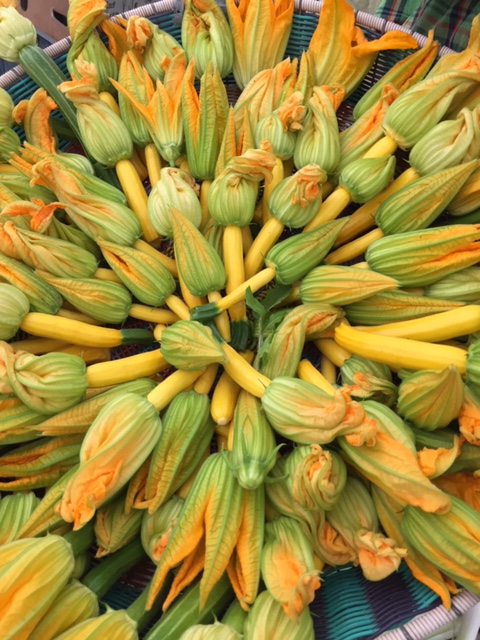
squash blossomes

I know. Another picture of spring’s beautiful bounty. I can’t help myself. Ballard Farmer’s Market, Sunday, May 17, 2015.

It’s official: Olive and I head to Boston tomorrow afternoon between workshops to spend a month with the family. I wish I could say I have the packing thing down but there seems to be a duffle bag  full of clothes that I can’t live without. Plus a roller bag ready with bits and pieces and the laptop. Also, a dog carrier by the door.  Alaska Airlines, here we come.

I spent the day going over some chapters, working in the backyard (no dirt untouched by me wherever I live, ever), and catching up on a huge pile of New York Times pages that have stacked up while I finished my workshops.

Olive

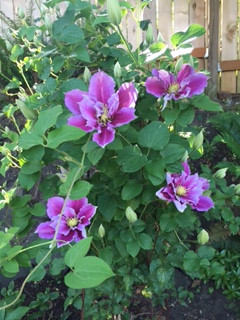
Olive and I took a walk around the lake early this morning and I am feeling sentimental. I have deepened friendships and trust with old and new writing friends. Chatted with some amazing authors. Increased my per-day espresso consumption, thank you Allison, at Cafe Vita. This may have been driven by the large dog biscuits passed over the counter, who’s to say. And thanks to this amazing weather, I was able to see the first blooms on my clematis, ‘Piilu.’

Clematis Piilu

See you soon from the other coast. Thank you for reading.

A. Dane

Standard
Uncategorized

Blood and Bones

The path to writing a memoir takes unexpected turns. A random prompt occurs and a writer finds memory peeling back to reveal a sudden moment of clarity. Take for instance my memory of milk. Add a workshop on emotional wounds. Dust this with the book, eating heaven, I picked up after hearing the engaging Jennie Shortridge at The Seattle University Search for Meaning Book Festival.

And there is another story in me:

When I was young, the age when I didn’t know distrust, to wonder what was happening, I went to the pediatrician with my mother. I recall the cold crackling paper on the table, sitting very still while the adult words were lobbed over my head.

“Milk.” “Too much.” “Fat.” “Powdered skim.” “Watch.”

Wait.

Fat?

What was that?

I was seven years old at the most. The table and my family were the center of my universe. Smooth, dairy-fresh milk was my favorite snack. Watch what?

I never was in charge of my body again. Fat was. Other people’s opinions were; french fries were removed from my plate, creamy whole milk banned, a small glass of powdered milk, blue and thin, at my place at the table each night. I learned to sneak snacks, spoon peanut butter from the jar while my mother was on the phone, hide cookies in my pockets. Eat more, faster, harder, alone, hide.

And this translated into a disassociation from my body. I approached the dining table for the next fifty years deciding what I would not eat instead of what I wanted to eat, or needed to eat. If my body was flawed, I had to control it like others before me.

This is not an unusual story for a woman born in the late 1950’s, the era of Twiggy, my mother eating cottage cheese and celery for a week to ‘diet,’ my grandmother patting my belly and exclaiming “what’s this!”

I’m not saying anything new. But I could DO something new when my first daughter was born in 1987. I banned the word ‘fat’ from my household, sat everyone down and declared this law. I did have control over the next important little girl. I intended that food, preparation, and love be the catalyst to gather together at the table.

This is not an essay on success, or failure, or blame. Our culture for thinness is strong and poisonous. My daughters navigated well, considering, and I am proud of them. I still ban the word.

I err towards information and power. A young woman I admire blogs to empower women around food issues. Her tag line reads:

“Be Happy. Be Bright. Be You.”

Pieces of my story slip through me and onto the page and I think about forgiveness and distortion and dis-ease with the blood and bones a creator gave me and I am both angry and sad. Can I undo what was done? Not really. But somehow acknowledging this dysfunctional relationship gave it a lot less power. Makes me more bright. More me.

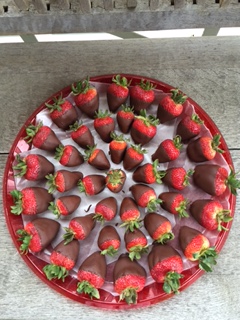
I ate the fortune cookie after my meal last night. Memory is a funny thing. I love strawberries, too.

Word count: 525IMG_6861

Standard
Uncategorized

Nepal is closer than you think.

Today I received an email from my niece. She wants the family to know something. And I want my readers to know something, too.

“My Nepali Adoptive Family Association has established a fund that is being distributed, by hand, to each of the orphanages that we came from.”

Sirjana is 7. To say she has thrived here in the US is an understatement. Her mother maintains close ties with other Nepalese adoptee families in the States, especially children adopted from the same orphanage. Sirjana’s roots are as firm in Nepal as in her American family, thanks to her mother’s perseverance. The Nepal earthquake disaster, as a result, is not so far away for Sirjana, for her Nepalese friends and now, for me. The earth shrank when I continued reading:

“These funds are being hand delivered to each orphanage as the needs are being assessed and allocations are being made on site. Some places need new homes, others only tents for temporary shelter. Some need medicines or food etc…. Each situation is unique and our Association receives reports each day from our person on the ground there – as well as pictures and notes.

For all the pleas we have seen for funds, her note struck me especially hard. How impossibly and unimaginably difficult the task of helping seems: Can you make a decision for funds, in those ruined villages, on an ‘as need’ basis? What is your criteria for ‘as needed’ when you look at the news coverage? Children? Animals? Shelter? Food? Roads? Our cultures are too different. Our houses too strong. I have felt helpless and privileged every night when I watch the news, shop for dinner, go to the gas station, pull a blanket over myself. I see Sirjana in the photographs.

Here are the children and their caretakers living outside of Sirjana’s orphanage, in fear of the building being further damaged from aftershocks.

11156267_878997282157227_2536500792793097202_n

Sirjana’s first grade class has also began gathering donations for the Red Cross Nepali Earthquake Relief Fund. They raised $1,000 in 12 hours. The class decided to push on and triple the donations.

Because of orphanages like the one Sirjana was raised in, we have a beautiful, smart and loving little girl in our family. Because of my donation, I will put a piece of tarp over a child’s head, or supply food, or fill a gas tank. So simple, and yet, so incredibly complicated.

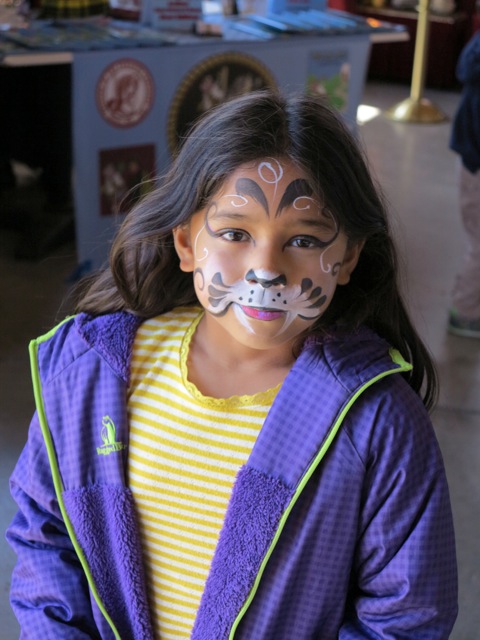
I am humbled. And grateful she asked her mom to sent us all a note. Nepal suddenly doesn’t feel so far away. And I don’t feel so helpless, after all. I’ll see what I can do to help, Sirjana. Thanks for writing me. Love the face paint.

Image 2https://www.crowdrise.com/firstgradestewardshipfornepal

 http://www.gofundme.com/swa2zy4c

Standard
Uncategorized

Grain of Sand

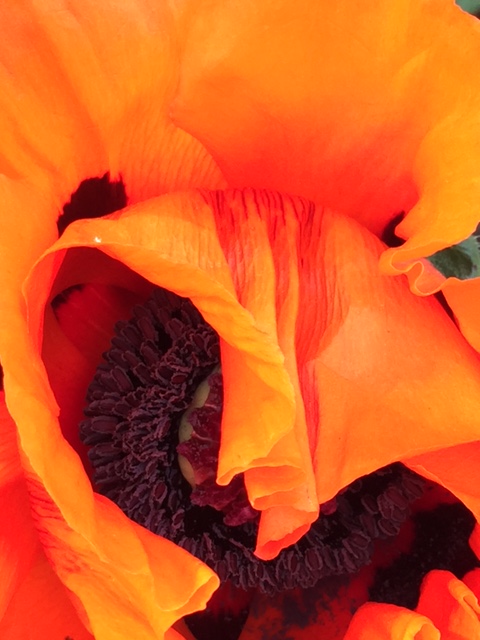
 poppy

     I am coming to the end of a program in Seattle, this writing group at the stage of cobbling our chapters together, making outlines for the chapters still simmering in our heads, dusting off book proposals, and in my case, sending a few chapters out into the publishing void, hoping for feedback, a nod, and the ultimate goal, publication. There is still much to do. Today, after a hand-written rejection note arrived, I realized the small details make a huge difference: Someone took the time to pen a note to me, not just clip a form letter to my work.

     I was feeling overwhelmed as this week unfolded, that my problems were like mountains– craggy, steep and snowy — perhaps impassible. Then other news began to leak in: A friend’s child has a severe swimming accident in France. A woman I adore loses the last of her hair, for the second time. Another woman friend had brain tumor surgery. Earth Day reminded me of a passionate young woman lost a year ago. My children are making life decisions. Then my piece was rejected.

     But the small gesture of a hand-written note elevated the rejection to another level, believe it or not. The personal words conveyed acknowledgment. I posted this on our writing group Facebook page and fellow writers sent me notes of encouragement and applause. I realized from their notes that I have a tribe, people like me in classrooms and living rooms and coffee shops, aiming to set into words stories and thoughts both personal and universal. Their words give me the confidence I need to sit down again to my work.

     Today I will write a dozen notes to friends I am thinking of — to congratulate them on birthdays and coming home and beautiful skin and special memorials and strength — writing on my blue note paper with a cheerful sparrow etched in the corner. And I will touch them as others have touched me, with small words, and remind them about their tribe that surrounds them near and far.

     I am a tiny piece of all that is happening around me. My problems survivable. I don’t have to climb them alone. I re-read the rejection note, a small gesture with large importance, and drop it into my ‘rejection’ file. Pull on my hiking boots and pull the laces tight. I will go smell the lilacs blooming down the street, and pause to admire the poppy that unfurled yesterday.

To see the world in a grain of sand

And a Heaven in a wild flower,

Hold infinity in the palm of your hand

And eternity in an hour.

(William Blake, fragment from ‘Auguries of Innocence”)

Standard
Uncategorized

Meet Me Under The Apple Tree.

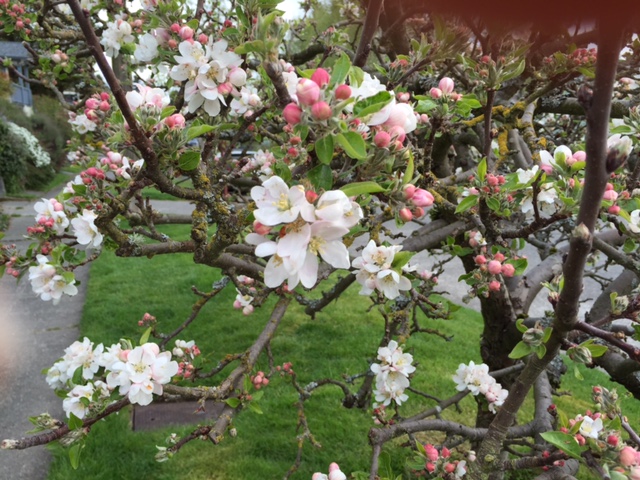
Appletree5.2015

I arrived back in Seattle last night, from the other coast still locked in the dregs of winter, discarded road salt and broken branches. A few of my hyacynth bulbs were poking through the leaf mold, and the lilac buds were setting strong and green, but spring itself is late and dawdling in Massachusetts after the record-breaking winter snows.

Traveling back and forth has been a time warp for me this season. Seattle spring has been weeks early and everlasting. It’s raining on Phinney Ridge today, but on my coffee walk I came upon a sweet little dwarf apple in full bloom, and my heart gave a little jump of joy.

I have a thing for apple trees. No doubt because when I was four years old, my parents purchased a defunct dairy farm in Guilford, Connecticut, circa 1800’s. For the next two years they converted the main barn into a contemporary home; a 20-foot high wide-beamed peaked ceiling, the main floor entirely open end-to-end, enormous green shag carpets, haylofts enclosed for our bedrooms, open balconies connecting the upstairs. My brother and I never knew walls. So unusual was the concept, we were even in a photo spread for House Beautiful in 1964. But what I remember most were the apple orchards. Especially now, fifty-two years later, when the sight and smell of an apple tree in spring makes my fingers itch to climb a limb and lean back into scratchy bark and breathe the spicy sweetness of the blossoms, aswarm with bees.

Having open space was almost as important as reading books for the child-me. But the two went hand in hand; with whatever series I was devouring tucked under my arm, I would set out into the orchard and either lean against the warm trunk or find a low branch to scramble. Picture being lost in a Nancy Drew conundrum, thrilling to the young reader, and lulled by the low hum of bees in the pale pink cloud of craggy branches. The world falls away. The words come alive.

Yes, sometimes I napped. And sometimes spending hours reading, alone in the country, was not the best social developmental plan for me. But I love how intrinsically woven together my memories of reading and the outside world are, thanks to that crazy decision my parents made fifty-two years ago.

Give them space and they will grow. And I did.

I am a reader now. I always carry a book. I read on park benches. I read on the bus. I am the type of person that can read anywhere — case in hand, I consumed an entire light-fiction airport paperback on my coast-to-coast trip yesterday. I didn’t look up until we descended. Not the two screaming children or the turbulence lifted my head for the five-hour flight. And the little tree today reminded me that I have a stack by my bed begging to be selected and dissected, despite the hydraulic drill next door or the construction below my apartment. And when it stops raining I may just sit a while under the branches and keep a look out for bees.

Thank you, Spring.

Standard
Uncategorized

Reunited.

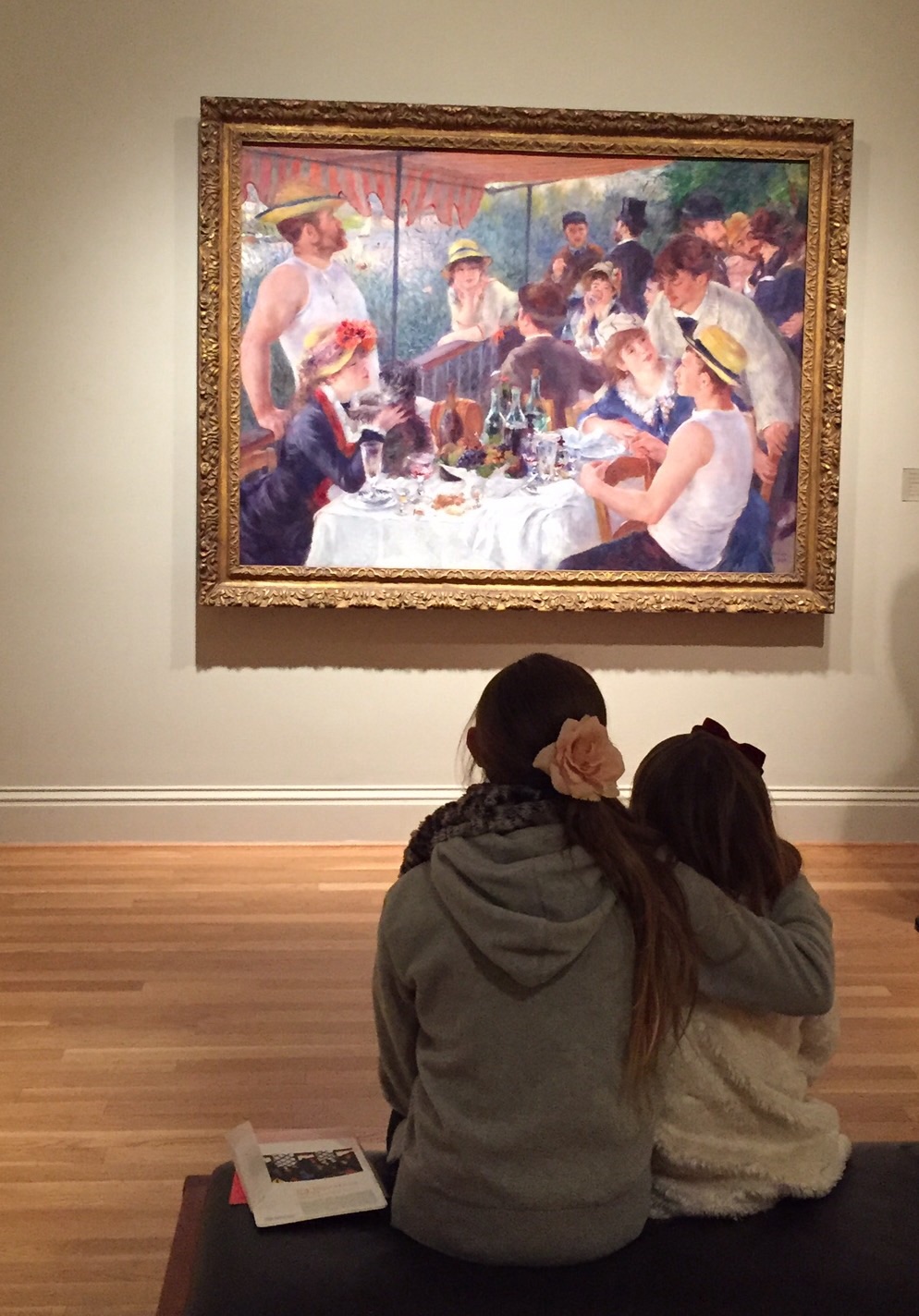
Today I was reunited with a first love. We met in 1969, on a worn plush bench at The Phillips Collection in Washington, D.C.  To the disgust of my artistic and hip mother, dragging me to galleries on spring break to ‘widen my horizon,’ I walked into one of the many parlor rooms, took one look at Pierre-Auguste Renoir’s Luncheon of the Boating Party (1881), and could not be budged. She glided off to meditate in the Rothko room, and I spent the next hour imagining and spinning tales, as only an eleven-year old can do, about the beautiful women and men caught laughing and eating on the larger-than-life canvas suspended on the wall.

Duncan Phillips (1866-1966) began amassing an astonishing collection of art as a young man, that he proceded to hang throughout his elegant Georgetown home. He believed that mixing all valuable art together, non-chronologically and non-traditionally — on walls and tables and cases — would demonstrate the ‘universality of art.’ Tea was taken under Klee and Buddhist tapestries. He read under Predergast hung with Miro. He walked the panelled hallways with Matisse looking over his shoulder, and Man Ray in the alcoves. And in 1923, the raucous and historic Boating Party found a home in the front parlor.

The house became a bonifide musuem in the 1920’s, purposefully retaining the trappings of a home amongst the art. When I scuffed my Keds through the door in 1969, there was no fee. We just walked through the front door and drifted through the house, still sparsely furnished with sofa’s and settees, and winessed the Duncans’ passion for collecting and memorializing paint, wax, metal, wood, canvas, ceramic, fabric. Art.

Impressionism impressed the romantic little girl in me. In the lower front left corner of Boating Party, a woman in a sprigged hat kisses a dog, elbows on the table, inches from a sumptious platter of fruit. A man sits backwards on a chair, admiring her. A straw boater tips towards a striped awning, the white t-shirt bright, a small red beard. A top hat moves in the background towards the rear. The water sparkles and the light deepens in the corner, suggesting lunchtime is long gone, the party is relaxed and no one is in a hurry to leave.

Today, I paid $12.00, clipped a pin on my collar, and pushed through glass and chrome doors to the now three wings of The Phillips Collection. I found my Renoir, in a similar room complete with a reproduction fireplace and a cushioned bench awaiting me in the center. I sat alone, and downloaded the Phillips Collection app for information on the painting. In the recording, the director of the collection explained the brush strokes, the models — all friends and colleagues of the artist — Caillebotte sits in the chair, Aline Charigot holds the terrier and later marries Renoir, Charles Ephrussi the art dealer wears the formal attire. And the list goes on.

We are not in 1969 anymore. Does the app take away the magic? Do the new galleries, built over the last forty years for the expansive collections, change the sense of living amongst Duncan Phillips’ art? Well, most probably I will forget the details in time, and I can now access the information whenever I want to, online, anytime. They galleries are still small, and the original house is mostly accessible, with a smattering of old and modern art sprinkled together, like old times. And all the floors are still wooden and still creak.

I went through the building top to bottom, enjoying a room made from wax and yes, the Rothko room. When I passed the Renoir one last time, I peeked into the room to say ‘goodbye.’ I am pleased to report Luncheon of the Boating Party has lost none of it’s magic. Not a cellphone in sight, just two little girls falling in love.

image

Standard
Uncategorized

B is for Best Moments

Olive

This morning, after the morning biscuit + espresso stop, Olive and I wandered under the riotous cherry and plum blossoms in our Greenwood neighborhood, reveling in the beauty of spring.

Down the hill a group of children were heading towards us, exuberantly shrieking “O is for Owl!” and “P is for Pot!” darting back and forth on the sidewalk in a wriggling mass of sweaters, tiny pink rain boots and dragging jackets, trailed by a young women with a clipboard, dutifully noting their Alphabet discoveries.

I stopped, conscious that not all adults like to have dogs around children, and waited for the woman to give me direction. But the children reached us in a flash, and Olive was surrounded by little heads and hands bent over her, asking if they could pet her. I thought her tail would wag off as she barreled right into the middle of the writhing mass, pressing herself against the legs of the nearest little boy.

A tiny girl in a tutu pointed down to her.  ” B is for Black!” she said. And then a little boy looked up at me and said, ‘your coffee cup is Black!” and another child hopped up and down and said ‘your tights and skirt are Black!”

“Even better,” I said, “her name is Olive!” and they all screamed, “Olives are Black!” and we had a great laugh. Then off they careened, pointing and shrieking and kicking up the blossoms on the hilly sidewalk.

I was turning when I felt a small hand on my leg. I looked down and saw that one little boy had come back down the street to me. Looking up solemnly, pointing with his outstretched arm, he said,

“Be careful, there’s a lion on the porch of that yellow house.”

I returned his gaze without a smile.

“Thank you,” I replied. “We will be very careful.”

He nodded, and skipped back up the hill to the group.

Made my day. Even the scary lion.

Revel in random moments, pink blossoms, and little rain boots. Life is good.

Standard
Uncategorized

Note To Self: 424 N. 68th Street, Seattle, WA 98103

letters

I am the keeper of the family letters. Boxes full. Old leather trunks full. Musty folders full. I have letters dating from the 1800’s, so crumbly I don’t take them out of the envelopes. Addressed with only the name and the town of my relatives. Stamped with a one-cent stamp.

An Organization professional would have a field day (yes you Susan Stone) but I hoard them like jewels. Each time I set a box on the floor or unbuckle a trunk, rifle through the onion skin airmail paper, see the familiar left-hand or right-hand slanted loops in royal blue ink, I dig a little deeper into the mysteries that were my family.

Recently, I am trying to decipher letters my mother wrote to her parents in 1955 from Spain, to round out some details in my memoir. She sort of ran away on the pretense of a semester abroad, a decision both Mount Holyoke College and my grandparents immediately regretted. A family story, a bit of romance, and a slippery stack of letters written in English, Spanish and ticked-off college student. I need full sunlight, complete patience and time to work through the papers. A lot of time.

After I spend some time on these letters, writing an email feels like a cheat to me, even though I send dozens a day. My New Year’s resolution has been to take one day a week and send handwritten cards, letters or postcards. Actually uncapping a pen, clearing my table, setting out my box of writing paper. To be truthful, after a few written sentences, the bend in my wrist actually feels a little awkward. Who isn’t accustomed to the ticking tapping speed of a laptop? Who besides me relies on the autocorrect slash of red to alert lazy spelling, the quick press of the ‘send’ button to land the message seconds later in the ‘mailbox’ of the recipient?

Instead, I resolved to spend the time, pick just the right paper or card, sit with tea and think about my words. I have to write the sentences in my head, script them in a measured movement, I even fuss with which stamp goes on which letter.

When I am finished, I feel so satisfied with the stack on the kitchen side table awaiting the next dog walk. The different colored envelopes, the saucy postcard graphics. I like to anticipate the parcel of letters in my pocket, the time it will take for the correspondence to travel and where they are going: To a metal mailbox, a brass mail slot, or perhaps slide under a heavy wooden door, wet with snow. Hands will touch the letters, hands will deliver the letters. Hands wrote these letters.

When I re-read my mother’s words, her funny requests for a certain wool suit, a check, my grandparent’s approval for another semester because she has fallen in love, I want to fall back in love. I want to take the trans-Atlantic ship to France. I want to slow down my life and watch the curling letters fill a crisp page. Her handwritten words capture a slower speed of being, a time of telling stories, of reading stories, of waiting for stories. I miss this.

I’m going to take the time to actually write, not just text or email. I don’t want to lose the art of taking time. And I’d love a letter. If you send me one, I will know you had to think about your words. Sign your name with a flourish.

I hope you do.

Perhaps someone will read the words you write to me fifty years from now, and remember.

Standard